
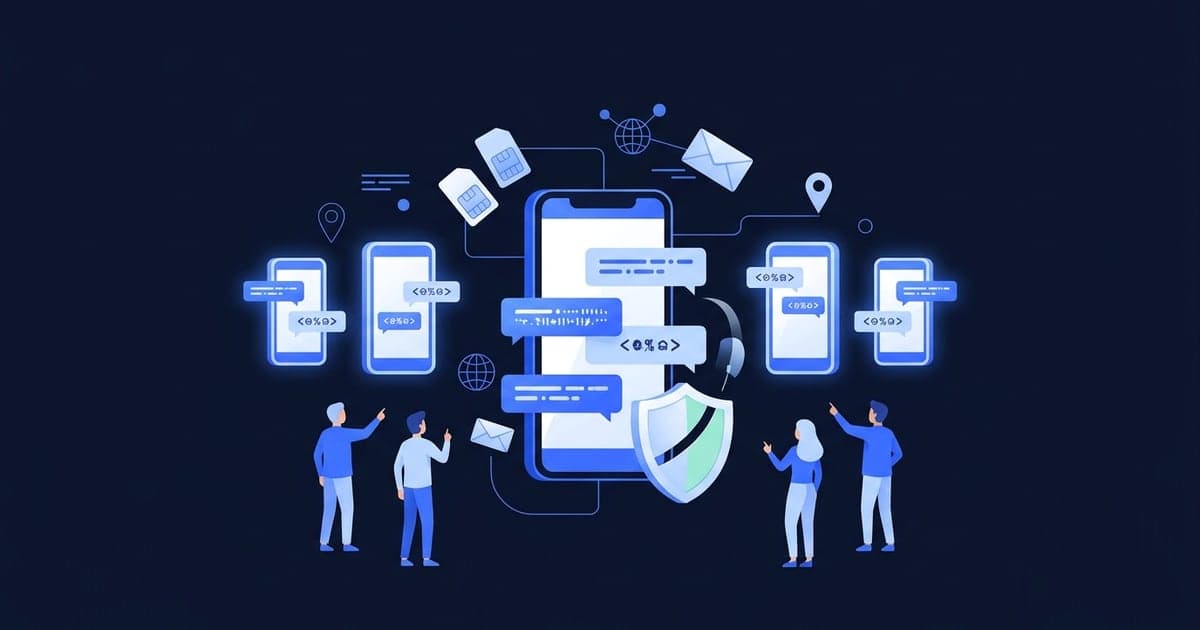
Free SMS number sites are safe for codes you'll never need again, as long as you remember that the inbox is public. Anyone who opens the same number sees every text sent to it, including your code. They're a poor choice for any account you want to keep, because the next person could use that number too.
The longer answer
A free receive-SMS number is shared on purpose. The site lists it, and whoever opens its page reads its messages. There's no password and no owner. That openness is the whole point: you get a number to try without giving the site your own number or email.
That same openness is the risk. A code you leave there can be read by the next visitor, and so can any code the service sends to that number later.
What other people can see
| Item | Can other visitors see it? |
|---|---|
| The codes and texts sent to the number | Yes, while they stay in the inbox |
| Your own earlier messages | Yes, they stay in the inbox for later visitors |
| Which service sent each text | Usually, the sender name or number shows |
| Your own phone number or email | No, you don't enter them to read a free inbox |
| Your account on the service you signed up to | Not directly, but see the first risk below |
The real risks
- Someone reuses the number on the same service. If the phone number is the login, or someone knows your username or email, they can ask for a new code to that number later. It lands in the same public inbox.
- Someone reads your code while it's fresh. Codes usually expire within minutes, but anyone can open the inbox at any moment, so enter yours straight away.
- Links in other people's messages. The inbox shows whatever was sent, including phishing texts. Don't click links you didn't ask for.
- Pushy ads on some free SMS sites. Some free SMS sites push pop-ups, fake download buttons or "verify you're human" pages. Don't install anything or type personal details just to read an inbox.
- The number is already on someone else's account. A shared number may already belong to an account on the same service, so a code could drop you into a stranger's account. Don't use it, and pick another number.
- The service turns against the number later. Some services flag shared numbers over time and refuse them, or ask accounts linked to them to verify again (why codes stop coming).
Common misconceptions
- "Codes disappear once I've read them." On most free sites, including freesmsnumbers.com, older messages stay in the inbox for the next visitor.
- "Nobody's on this number right now, so it's private." Anyone can open it later and scroll back.
- "If the site looks clean, the number is safe to keep." A tidy page says nothing about who else has used the number, or who will use it next.
How to use a free number safely
- Use it only for sign-ups you'd shrug off losing: a trial, a coupon, a one-time download.
- Pick a number from the free numbers by country list and enter the code as soon as it arrives.
- If the service lets you, add your own email or an authenticator app and switch off SMS login.
- Never use a free number for banking, email, work or anything with your real identity on it.
- Don't reply to or click anything in other people's messages.
For anything you'll come back to, a free number is the wrong tool from the start (when a temporary number fits).
A private number, and what Virtual Number shows
On freesmsnumbers.com the free numbers are public: anyone can open an inbox, and older messages from other visitors stay visible. You don't enter your own number, name or email to read one.
If you'd rather nobody else could read your code, use a private activation in the Virtual Number app for Android or iOS. You buy credits, choose a country and a service, and only you can see that activation's messages. After 20 minutes the number may stop receiving messages, so it can't help with a password reset next month (free vs paid numbers).
Need a quick code? Pick a number on Virtual Number for low-stakes sign-ups, and switch to the app when the code needs to stay yours.